


The Unified Pension Scheme (UPS) was officially launched, which led to a paradigm shift in India’s retirement market. The Finance Ministry also said in a notification about the operation of UPS as an option available under the National Pension System (NPS) to central government employees, starting from April 1, 2025. For millions of government servants left stranded in the purgatory between two extremes of market-linked pension uncertainty and nostalgia for guaranteed Old Pension Scheme (OPS) benefits, UPS is a viable middle-path.
What is the Unified Pension Scheme of India?
The Unified Pension Scheme is a hybrid pension system for government employees, and it will be funded by the center. Instead, it is a hybrid pension model that aims to combine the best features of the OPS – i.e., guaranteed working and benefits in terms of say deducting up based pensions and therefore ensuring opportunities for retired security, but through a contribution-based system as well, like NPS, enabling all employees to be covered under this umbrella.
The T.V. Somanathan Committee(2023), which reviewed the NPS, recommended the UPS. This announcement was released on the 22nd of August, 2024, and implemented from April 1st, 2025, as a voluntary pension scheme for central government employees under NPS.
The scheme will be on a defined contribution-based, defined benefit guaranteed basis, which is a major difference compared to the NPS, which relies solely on market factors. With UPS, both the employee and the government make regular contributions, but what ultimately gets paid out as a pension is guaranteed, rather than tied to market performance.
Some Key Factors of the Unified Pension Scheme
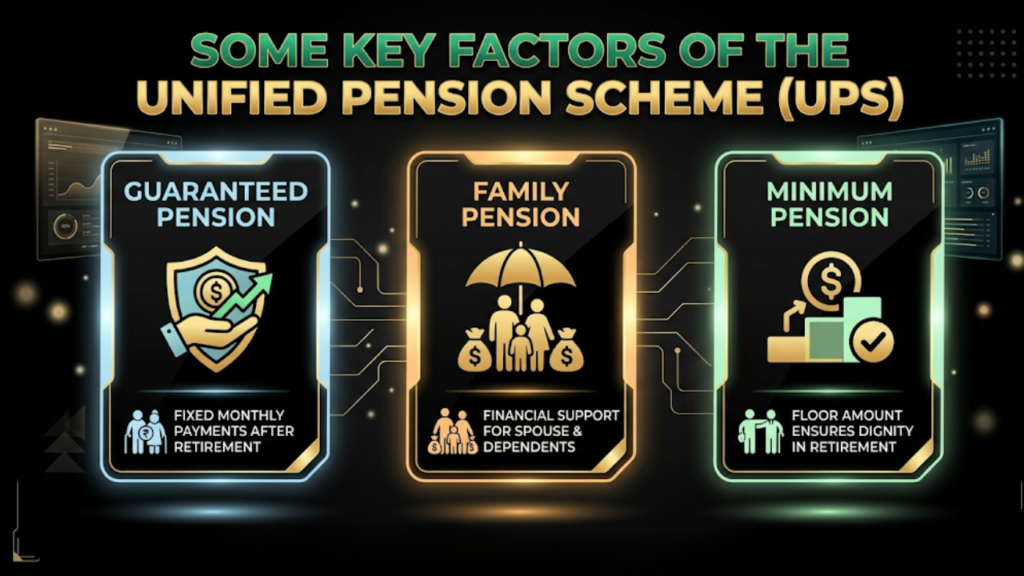
Assured Monthly Pension
Under the unified pension, employees get 50 per cent of their average basic salary (during the last 12 months) at retirement, if they serve for 25 years.
Minimum Pension Guarantee
Even if the service is shorter (minimum 10 years), the unified pension scheme guarantees a minimum of ₹10,000 per month.
Family Pension
If the employee dies, 60 percent of the pension gets passed on to family members.
Inflation Protection
Dearness Relief (DR) based on inflation was included in a unified pension plan, so the worth of pensions does not depreciate over time.
Government Contribution
- Contribution of the employee: 10% salary + DA
- Government Contribution: 18.5%
Read more: PM Internship Scheme | MyUday.Lupin.com Login
Eligibility for Unified Pension Scheme
Eligibility for retirement under the scheme:
Central Government Employees
Central government employees are the primary beneficiaries of this scheme.
Minimum Service Requirement
- 10 years: Minimum pension eligibility
- 25 years: Full pension benefits
Existing NPS Subscribers
Those who are already registered under NPS can transfer to a unified pension if it is done before a deadline.
New Recruits
Employees joining the central government after April 1, 2025, may be automatically covered under the unified pension scheme.
Unified Pension Scheme vs NPS
How many employees are confused between NPS and the unified pension? Here’s a simple comparison:
| Feature | Unified Pension Scheme | NPS |
| Pension Type | Guaranteed | Market-linked |
| Risk | Low | High |
| Returns | Fixed | Variable |
| Inflation Protection | Yes | Limited |
| Family Pension | Yes | Limited |
Is UPS better than NPS?
A unified pension scheme is an advantage for:
- Risk-averse individuals
- Those seeking a fixed income
- Employees who prefer stability
But since NPS invests in the market, it might offer better returns over a longer duration. So, it’s a matter of risk tolerance.
Unified Pension Scheme Portal
That scheme seeks to bring all pension schemes under one official portal for registration and tracking.
Portal Features:
- Online registration
- Application tracking
- Pension details access
Read more: Gruhalakshmi Scheme | NPS Scheme
Switching from NPS to UPS
The employees can apply for the unified pension through their visit to the official portal from Protean (NSDL).
Unified Pension Scheme App
There is presently no single app dedicated to the services that are available via:
- Government pension portals
- Mobile-friendly websites
A separate unified pension app may also be launched for more thorough accessibility and tracking of the same.
Unified Pension Scheme Notification PDF
The reminder issued through a government notification is in respect of the official guidelines and rules regarding the `unified pension scheme.
“What You’ll See in the Notification PDF:
- Scheme rules
- Eligibility conditions
- Contribution structure
- Pension calculation formula
For all the correct updates, employees are requested to read the pension scheme notification in PDF format from official government sites.
Unified Pension Scheme (UPS) Application Process
Applying for the unified pension scheme is an easy process that can be done both online and offline. The following is a detailed step-by-step explanation of each process.
Online Method (Step-by-Step Guide)
Step 1: Go to the Unified Pension Scheme Portal
Visit the official unified scheme portal (the Protean/NSDL website). This is the primary platform through which all services access delivery for pensions.
Step 2 – Registration is the next step in doing the
On the homepage, search for options that say:
- “New UPS Employees Register Here”
- “Migrating from NPS to UPS” (for existing NPS subscribers)
Please select the option that best suits you.
Step 3: Enter the Required Information
Carefully fill in all required information, such as:
- Name and personal details
- Employee ID and department
- Date: Join and impart training in
- Salary and bank account details
Check for the accuracy of all information to avoid rejection or delay.
Step 4: Upload Documents
Attach relevant documents, which can include:
- Identity proof (Aadhaar, PAN card)
- Address proof
- Service certificate
- Passport-size photograph
Make sure that file formats are readable, and documents are clear.
Step 5: Submit the Application
Finally, check all information and click on the “Submit” button.
Your application will be assigned an acknowledgement number or a reference number that you can use to track your application status.
Offline Method (Step-by-Step Guide)
Step 1: Download the Application Form
Download the form of the unified pension scheme from the official portal or your department office. Depending on your status (new employee, NPS subscriber, retiree, etc.), different forms are available.
Step 2: Fill in the details carefully
Fill the form manually as follows:
- Personal information
- Employment details
- Pension preferences
To avoid errors, double-check all entries.
Step 3: Submit to Your Department (DDO)
After filling in the form, submit it to your DDO (Drawing and Disbursing Officer)
The DDO verifies your details and forwards them.
Step 4: Verification and Processing
- DDO verifies your documents with the service records
- It is then sent to the Pay and Accounts Office (PAO)
Your enrolment in the pension scheme is complete after approval
Important Tips
- Always keep a copy of the application
- If you apply online, check the status of your application
- Please reach out to your HR/DDO if you need help
- File before the actual due date (particularly for the NPS move)
Unified Pension Scheme: Which State Has Rolled It Out?
So far, the unified pension has been implemented for central government employees.
However:
- One of the first states that has expressed interest in implementation is Maharashtra.
- The other states will follow the unified pension scheme.
The unified pension, if adopted on a large scale, would be relevant for lakhs of government servants in India.
Calculation of Pension in Unified Pension Scheme
Let’s understand with an example:
- Average Basic Salary: ₹80,000
- Service Period: 25 years
Pension Calculation:
- 50% of ₹80,000 = ₹40,000/month
Thus, the pension in case of the introduction of a unified pension scheme will be ₹40,000 per month.
Recent Updates on EPFO Pension 95
Recent updates suggest:
- Demands to raise EPFO Pension (EPS-95) are being considered by the government
- Retiring people demand a basic pension of ₹7,500 or more
- Negotiations are still being conducted, and nothing has been finalized
Although separate from the EPFO pension, the unified pension signals a larger push to enhance retirement security in India.
Benefits of Unified Pension Scheme
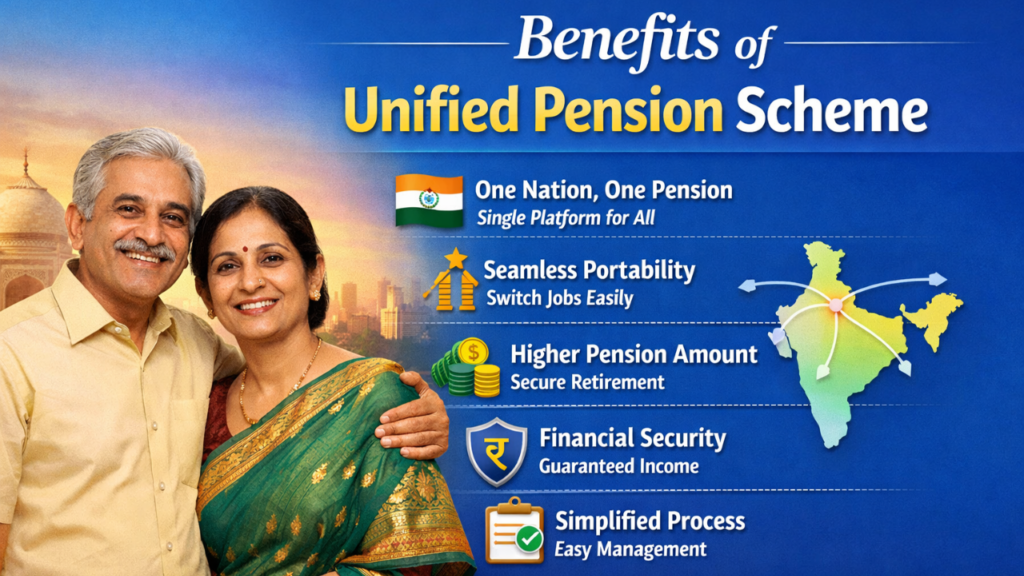
Financial Security
The unified pension scheme guarantees income after retirement.
No Market Risk
The performance of the equity market does not affect the unified pension scheme, unlike NPS.
Family Protection
Family pension is a way to financially secure the dependents.
Inflation Protection
- Regular tweaks help preserve buying power.
- Stability for Long-Term Planning
So, this is a perfect one for a secure retirement.
Conclusion
The unified pension scheme will pave the way for broader financial security for all government employees across India. A pension with guaranteed inflation protection and family benefits makes it a secure retirement plan.
NPS is market-linked, and its growth is not guaranteed, while the unified pension provides safety and predictability. The choice between them is a matter of your financial goals and risk appetite.
If you prefer stability and guaranteed returns, then the unified pension is certainly one of the best retirement options in 2026 and beyond.

Leave a Comment