
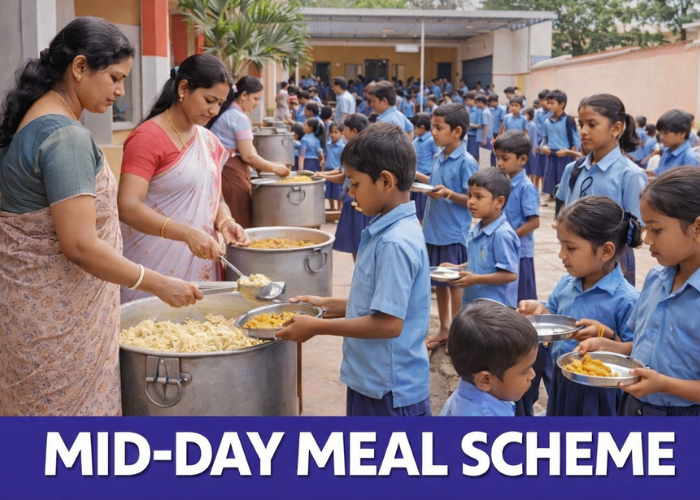

The Mid-Day Meal Scheme is one of India’s flagship social safety nets aimed at improving child nutrition with a focus on incentivizing school attendance and reducing dropouts. The program has revolutionised the education sector since its introduction, serving mid-day meals to 100s of millions of school-going children with mid-day meals.
In this comprehensive SEO guide, you will learn everything about the Mid Day Meal Scheme, which was introduced in India along with its history, aims & objectives, advantages of the Midday meal scheme, latest updates 2026, menu details under the scheme, ministry news, and how to access the official PDF for mid-day meal scheme for authentic information.
What is the Mid-Day Meal Scheme?
The Mid-Day Meal Programme is a government scheme that provides free cooked meals to children studying in government and government-aided schools throughout India. The focus is to enhance the nutritional status of school-going children with a view to improving literacy and fostering attendance at school.
This scheme is currently running under the PM POSHAN (Pradhan Mantri Poshan Shakti Nirman) program by the Ministry of Education with full assistance from the Government of India.
Mid-Day Meal Scheme Launched in India – History and Background
India’s Mid Day Meal Scheme was introduced at the national level on 15 August 1995 as the “National Programme of Nutritional Support to Primary Education (NP-NSPE). However, other states had already launched the program by then.
Mid-Day Meal Scheme Pioneer State
The first state which widely implemented the Mid Day Meal Scheme was Tamil Nadu, where a scheme was introduced by the then Chief Minister M.G. Ramachandran in 1982, and also became the first State to introduce a cooked programme. The model was so successful that it led to the national expansion.
Mid-Day Meal Scheme: Objectives
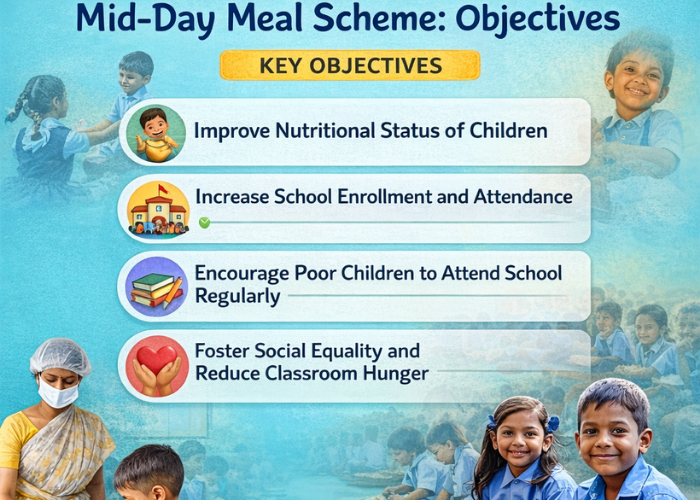
The model was introduced with multiple critical aims:
Enhance nutrition among children
Schoolchildren receive a balanced diet, cooked meals in the scheme to counter hunger and malnutrition. Some students are from low-income families that do not give them access to nutritious food, so the meal helps ensure they get nutrients crucial for healthy growth and brain development, including proteins, vitamins, and calories.
Increase school enrollment and attendance
Providing free meals incentivises parents to send children to school, particularly in rural and less affluent areas. The guarantee of a meal motivates enrolment and better attendance.
Reduce dropout rates
With children getting meals at school, there is less pressure on families, who are unlikely to pull their kids out of school for work or housekeeping. This helps to retain students in the system longer.
Promote social equality
The process of making the children from various castes, religions, and economic classes sit and have their meals together will initiate them into inclusivism, break down social barriers, and instill respect for one another by drawing them close.
Healthier is more educated: Making the case for quality education as a form of health improvement. Well-fed children tend to be more alert, active, and able to learn. Good nutrition helps focus and cognitive ability, which leads to better learning and academic success.
Mid-Day Meal Scheme: Which Ministry?
It is handled by the Ministry of Human Resource Development at the central level and by the State Government/Union Territory at the state level.
Salient Features of the Mid-day Meal Scheme
Free Nutritious Meals
Children studying in classes 1 to 8 get free cooked food on school days.
Wide Coverage
The scheme covers:
- Government schools
- Government-aided schools
- Local body schools
- Special training centers
Nutritional Standards
Dietary requirements are based on a specific amount of calories and protein.
Community Participation
Local self-help groups and community organizations frequently contribute to the cooking.
Mid-Day Meal Scheme Menu – What Is Served To Children?
The Mid-Day Meal Scheme menu differs from state to state but adheres to nutrition norms. Typical meals include:
- Rice or wheat
- Dal (lentils)
- Vegetables
- Eggs or milk (in many states)
- Khichdi
- Seasonal fruits
Sample Weekly Menu
| Day | Meal Example |
| Monday | Rice, dal, vegetables |
| Tuesday | Khichdi with vegetables |
| Wednesday | Roti, sabzi, dal |
| Thursday | Rice, sambar, egg |
| Friday | Vegetable pulao |
| Saturday | Sweet dish + dal rice |
Nutritional Norms
These are the minimum nutrition standards the government imposes:
Primary Level (Classes 1–5)
- 450 calories
- 12 grams of protein
Upper Primary Level (Classes 6–8)
- 700 calories
- 20 grams of protein
The Impact of the Midday Meal Scheme
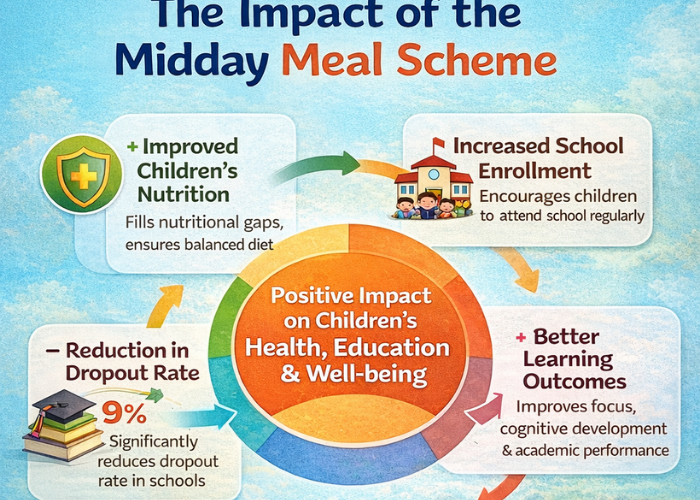
Improved Child Nutrition
Millions of kids get at least one nutritious meal each day.
Higher Enrollment Rates
Parents are also more inclined to send their children to school.
Reduced Dropout
The program is a way to keep students, especially in rural areas.
Social Inclusion
Children from different castes and communities have meals together, fostering equality.
Women Employment
Many of the cooks and helpers are women, contributing to local employment.
Better Academic Performance
Healthy kids are more focused and do better in school.
Read more: Kanya Sumangala Yojana | PM Matru Vandana Yojana | EPDS Bihar
Mid-Day Meal Scheme 2021 - Key Changes
In Mid-Day Meal Scheme 2021, the government revamped the program and revised it to PM POSHAN, better known as compared to:
- Increased access for pre-primary pupils in some areas
- Emphasize school nutrition gardens
- Better monitoring through technology
- Inclusion of local food diversity
- Strengthened food safety measures
It is the implementation of these reforms that still has a bearing in 2026.
Latest Updates for 2026 – Mid-Day Meal Scheme
Here are the recent developments:
- Increased application of electronic monitoring systems
- Focus on fortified foods to fight malnutrition
- Increased budget allocation
- Improved kitchen infrastructure
- Compatibility with health programs, such as anemia screening
The government is also striving to incorporate millets into school meals to improve dietary intake among school children.
How the Scheme is Implemented – Mid-Day Meal Scheme
Central Government Role
Policy formulation
The central government, which designs the overarching framework of the scheme, lays down nutrition norms and framing rules so that implementation is uniform across the country. It also adjusts policies in response to feedback and changing needs.
Funding support
A large chunk of the funding comes from the Union government for costs such as those incurred on foodgrains, cooking costs, and infrastructure support inthe form of kitchen shacks or godowns.
Monitoring and guidelines
Operational guidelines are issued by the Central, reviews are undertaken, and progressis tracked through reports and digital systems to ensure operational efficiency of the scheme.
State Government Role
Meal preparation
Arrangements for cooking and cooking staff, including a cook and a helper, are organized by the State Government, and the meals are to be prepared as per specified nutritional norms.
Local procurement
States generally purchase locally produced vegetables, pulses, and other ingredients to help farmers and ensure hot meals are served.
Quality checks
Food quality, safety, and hygiene control are also performed by state officers through regular inspections.
Distribution
States, meanwhile, handle arrangements for the delivery of food grains and other supplies to schools as per schedule in an efficient manner so that there are no breaks in serving meals.
School Role
Ensuring hygiene
Schools have to keep a safe kitchen, clean drinking water, and basic sanitation so they can safely produce and serve meals.
Maintaining records
Meal menus, attendance, stock utilization, and expenditure are documented in schools to ensure transparency and accountability.
Supervising meals
Teaching and non-teaching staff monitor the serving of food so that every child gets food in an orderly way , and also to ensure discipline and cleanliness.
Monitoring and Transparency – Mid-Day Meal Scheme
To ensure accountability:
Schools maintain daily meal registers
Attendance and meal distribution are counted on a daily basis to monitor coverage and gaps.
Inspections are conducted regularly
Education and local administration officials visit schools to review the quality of the meals, hygiene, and adherence to guidelines.
Online portals track implementation
Data is uploaded, fund utilisation is monitored , and progress is tracked in real time on the digital platforms.
Social audits are encouraged
Journalism and broadcasting organizations, parents and community residents, and local governing bodies also take part in reviews to guarentee openness.spyware-freetalking.jpg Journalists examine spyware-free. “We have the developers being completely open,” says ACC’s Davies.
Mid-Day Meal Scheme PDF – How to get Official Documents found here
You may download the official guidelines, reports, and circular of the Mid-Day Meal Scheme PDF. website – pmposhan.education.gov.in
- State education department portals
- Government reports section
These PDFs contain specific rules, menus, funding standards, and implementation guidance.
Challenges Faced by the Scheme – Mid-Day Meal Scheme
But even if it proves to be successful, the scheme also has some hurdles:
Occasional food quality issues
Complaints have been lodged in some areas about bad food quality or contamination. Such problems can be caused by inadequate supervision, storage, and training of kitchen personnel.
Infrastructure gaps in remote areas
Some schools in rural areas or that are remote may not have suitable kitchens, storage space, and clean water to prepare food safely regularly.
Delays in fund release
“Administrative processing delays can affect meal preparation, often requiring schools to make do with fewer funds or make temporary food arrangements.
Monitoring difficulties
It’s difficult to maintain consistent supervision in thousands of schools, so enforcement can be erratic.
Regional disparities
The scheme’s quality and effectiveness are different for every state based on local governance, availability, and administrative flaws.
The current round of reforms is grappling with this problem through more comprehensive digital tracking, tighter inspections, and better means of funding.
Read more: Mission Prerna Scheme | PM Surya Ghar Muft Bijli Yojana
Role During Emergencies
During pandemics, or when schools are closed, many states offer:
- Dry ration distribution
- Direct cash transfers
- Take-home rations
This has meant that children would continue to be provided with nutrition support.
Impact on Society
The Mid-Day Meal Scheme is proving to be very effective:
Improved literacy rates
Increased enrolment has resulted in better literacy, particularly among disadvantaged children.
Reduced child hunger
Meals reduce hunger to be more alert in studies and better life.
Enhanced gender parity in education
When meals are provided, families are also more likely to send girls to school, narrowing the gender gap in education.
Better health for rural populations
Children are growing taller and more muscular than their bodies might have allowed them to grow before they had better nutrition - an interesting phenomenon, that!
One of the biggest school meal programs in the world
The program is a global model and impacts millions of children around the world every day.
It’s said to be one of the world’s largest school feeding programs.
Who is Eligible?
Children eligible include:
The scheme covers:
Class 8 and below in government schools
The children in primary and upper primary are provided with food.
Students in government-aided institutions
Government-assisted schools are also included to achieve the widest coverage.
Children in special training centers
Out-of-school children attending bridge classes or special programs also benefit.
How Schools Manage Food Safety
Schools follow strict guidelines:
Clean cooking areas
Kitchens are regularly cleaned and sanitized to avoid tainting.
Safe drinking water
The authors report that there is clean water for cooking and cleaning of utensils to keep hygiene.
Regular health checks for cooks
Chefs and kitchen assistants are health-screened to mitigate the probability of sick food.
Use of quality ingredients
Schools have been told to rely on fresh and approved food.
Food samples are tested
Authority may do a test on random samples to verify they comply with safety and quality standards.
Some tension samples are also tested to ensure the quality.
Importance of Community Participation
Mid-Day Meal Scheme Local actors are crucial because:
Monitoring meal quality
Parents and local groups assist in monitoring the quality of food, and signal if there are alarm bells.
Supporting infrastructure
Communities might contribute resources to or facilitate upgrading the schools themselves.
Ensuring transparency
The evidence is clear that public involvement leads to more accountability and less waste of money.
Encouraging enrollment
School enrollment is driven by community mobilization campaigns.
Role of parent-teacher associations
They typically oversee the rollout and offer feedback.
The way forward for the Mid-Day Meal Programme
For its part, the government intends to:
Expansion of coverage to additional age groups
New benefits for pre-primary or secondary students could also be considered.
Using technology for real-time monitoring
Apps and digital dashboards have been created to track meal delivery, attendance at those sites, and the use of the funds.
Improving nutrition diversity
Including fruits, fortified foods, and a regional menu to improve nutritional quality.
Strengthening supply chains
More efficient logistics lead to the timely delivery of food grains and ingredients.
Promoting locally sourced foods
Local purchase also helps provide for local farmers while ensuring that meals are fresh.
👉The program will remain a cornerstone of India’s education and nutrition strategy, and it will ensure millions of children can learn and grow in a healthier environment.
(FAQs)
Mid-Day Meal Scheme, which year started in India?
It was nationally introduced in 1995.
Which ministry runs the scheme?
It’s controlled by the Ministry of Education.
Which state started it first?
Tamil Nadu pioneered the program.
What is served in Mid-Day Meal Scheme?
Normally, meals consist of rice accompanied by dal, vegetables, and often eggs or milk.
Conclusion
This is a laudable scheme for education, nutrition, and social development in India. From attendance rates to malnutrition, the initiative still helps millions of kids daily.
Through continued reform, digital tracking, and better nutritional standards, the scheme is changing to cater to the next generation. History benefits ministry oversight menu. The idea of launching the Mid-Day Meal Scheme in India has emerged through a long process for makinga better, healthier, and more educated nation.


Leave a Comment